Most CIOs don't need to write a line of code. But every CIO now needs to be able to sit in a vendor pitch or an architecture review and know whether what's being proposed is actually sound — or just a demo wearing enterprise clothing. This week's piece is a working vocabulary: the core patterns behind production AI systems in 2026, what each one is actually for, and where the risk hides.
Most CIOs don't need to write a line of code. But every CIO now needs to be able to sit in a vendor pitch or an architecture review and know whether what's being proposed is actually sound — or just a demo wearing enterprise clothing. This week's piece is a working vocabulary: the core patterns behind production AI systems in 2026, what each one is actually for, and where the risk hides.
1. RAG: Grounding AI in What You Actually Know
Retrieval-Augmented Generation (RAG) is the pattern that lets an AI system pull from your enterprise knowledge — documents, tickets, manuals, past cases — instead of relying purely on what the model learned during training. A query comes in, relevant content is retrieved from a vector database, and that content is fed to the model alongside the question so the answer is grounded in your actual data.
Why it matters to you: RAG is the single biggest lever against hallucination in enterprise AI. Organizations that implemented it well saw meaningfully better response accuracy than static model outputs. But RAG quality is a data problem before it's an AI problem — retrieval is only as good as how well your content is chunked, indexed, and kept current.
Watch for: "Permission-aware" RAG. A retrieval layer that ignores document-level and row-level access controls will happily surface a salary spreadsheet to someone who shouldn't see it. This is a governance question, not just an engineering one — ask explicitly whether your RAG layer respects existing access permissions or bypasses them.
2. MCP: The Nervous System Connecting Agents to Everything
Model Context Protocol (MCP), introduced by Anthropic, has become the standard way AI agents connect to external tools, databases, and APIs — think of it as a universal adapter, so an agent doesn't need custom-built integration code for every system it touches. It's now governed by a cross-industry foundation under the Linux Foundation, with Anthropic, Google, OpenAI, Microsoft, and AWS all participating, and adoption has scaled into the tens of millions of downloads.
Why it matters to you: Before MCP-style protocols, every agent-to-tool connection was custom-built — expensive, brittle, and a maintenance burden that grew with every new tool. Standardizing on an open protocol here is the difference between an architecture you can evolve and one that locks you into a single vendor's roadmap.
Do this: When evaluating any AI vendor or platform, ask directly: "Is this MCP-native, or is this a proprietary integration layer?" The answer tells you a lot about your future switching costs.
3. Agent Orchestration: Who's in Charge When AI Does Multi-Step Work
A single AI agent calling a tool in a loop works for narrow tasks. It breaks down once the task gets complex — "automate quarterly financial reporting" isn't one step, it's a workflow. This is where orchestration patterns come in. The common ones worth knowing:
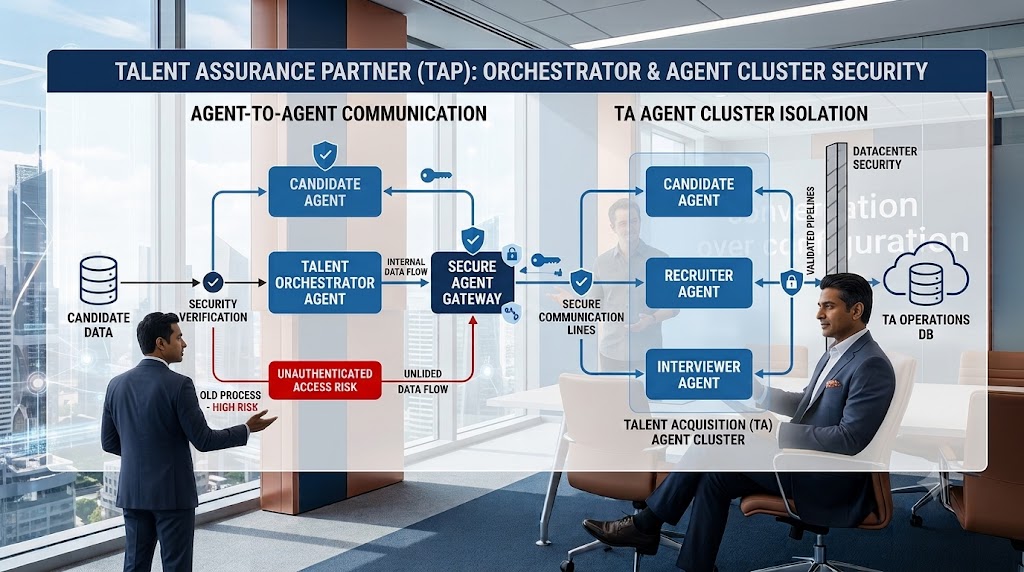
- Orchestrator–Worker: A lead agent owns the goal, breaks it into steps, and dispatches specialized worker agents to execute each one.
- Supervisor Routing: A supervisor agent classifies an incoming request and hands it to the right specialist — useful for anything resembling triage (support, IT tickets, intake).
- Handoff Models: One agent explicitly transfers control and context to another — common in customer-service style flows moving between billing, technical support, and account management.
- Agentic RAG: A retriever agent finds the information, a separate synthesizer agent turns it into an answer or action — separating "finding" from "deciding."
Why it matters to you: The orchestration layer is what turns a collection of clever AI demos into a system you can actually run and audit. Without it, you get brittle point solutions that break the moment a model updates or an API changes — a common failure pattern this year. With it, you can swap underlying models or vendors without rebuilding the whole system.
The honest number to know: Most enterprises are still stuck at the pilot stage. Broad adoption of generative AI hasn't translated into broad business impact — the gap tends to be "horizontal" copilots with diffuse, hard-to-measure gains instead of "vertical" agents anchored to one specific, measurable business process. If your AI investment doesn't map to a single owned process with a clear before/after metric, that's your first architecture problem, not your last.
4. Security: The Layer That Can't Be Bolted On Later
Three things to build into the architecture from day one, not retrofit:
- Identity and access control at the agent level — an agent should carry the same permission boundaries as the person or process it acts on behalf of, not a blanket service account with broad access.
- Sandboxed execution — any agent capable of running code or calling external systems needs to do so in an isolated environment, separate from your core network.
- Human-in-the-loop rules, codified — decide in advance which actions require human sign-off (financial transactions, customer communications, data deletion) and enforce it structurally, not through a policy document nobody reads.
Why it matters to you: Deploying autonomous agents introduces security, compliance, and cost risks that don't show up in a proof-of-concept. The architecture review question that matters most: "What happens if this agent is given a malicious or malformed instruction — what's the blast radius?" If nobody in the room has a crisp answer, the system isn't ready for production.
The Bottom Line
RAG grounds the model in your data. MCP standardizes how agents reach your tools. Orchestration decides who does what and in which order. Security decides what happens when something goes wrong. None of these are optional for a production system — they're the difference between an AI pilot that impresses in a demo and an AI system your business can actually depend on.

Compiled by Mr. Hareesh from current enterprise AI architecture analysis, including sources on MCP/A2A protocol adoption, agentic orchestration patterns, and 2026 enterprise AI ROI research (McKinsey, Deloitte TMT Predictions 2026).